Wednesday, September 8, 2010
Açucar!
The Brazilian love affair with things sweet was nicely summed up in an exchange I had yesterday. I was making myself a cafezinho (~ espresso) the way I've come to like them here - small, black, syrupy and unsweetened. A brasileiro looking on exclaimed "Are you having it raw?!?!", and then grimaced - I said yes, raw - and we both laughed. Clearly it's quite un-Brazilian to have your coffee 'raw', sem açucar!!

Monday, September 6, 2010
Joga bonita
I had a very Brazilian futebol moment in Brazil yesterday! After seeing and hearing very little about the round ball game, scarcely any joga bonita to speak of (but lots of fireworks in São Paulo for the centenary selebrations for Corinthians), I was in the car with Thiago and Jane driving back to Belo Horizonte from Serra do Cipó.
First some background … there are two first division football teams in Belo Horizonte - Cruzeiro (doing rather well this year - Jane’s team) and Atlético Mineiro (languishing near the bottom of the table since about 1972 - Thiago’s team). The big stadiums (and they are huge, particularly Minarão) in BH are closed for renovation, in preparation for the World Cup in Brazil in 2014. The home games are therefore being played in the interior of Minas Gerais state, 3-4 hours drive away and out of the reach of most of the fans. Home games are not broadcast free to air in the state of origin either - but for a princely sum (R$50-70) you can see them on cable.
In amongst listening to music, Thiago was occasionally tuning the radio to the Cruzeiro v. Palmeiras game to annoy Jane, as Cruzeiro were trailing 0-1. At some stage we heard a roar from the surrounding cars in the traffic jam in Santo Lago - Cruzeiro had obviously scored a goal in play. There happened to be a bar nearby screening the game on cable TV, and most of the nearby cars tried to get in line to watch the replay. I was laughing, but everybody else was deadly serious.
Later that night São Paulo defeated Atlético Mineiro 3-2, but for Thiago’s sake I will leave it at that ...
Incidentally, Cruzeiros won … but if you need a solid bet for national champions this year, it’s Fluminense from Rio de Janeiro, and daylight second - so the local experts tell me (and they are, mais ou menos, all experts).
First some background … there are two first division football teams in Belo Horizonte - Cruzeiro (doing rather well this year - Jane’s team) and Atlético Mineiro (languishing near the bottom of the table since about 1972 - Thiago’s team). The big stadiums (and they are huge, particularly Minarão) in BH are closed for renovation, in preparation for the World Cup in Brazil in 2014. The home games are therefore being played in the interior of Minas Gerais state, 3-4 hours drive away and out of the reach of most of the fans. Home games are not broadcast free to air in the state of origin either - but for a princely sum (R$50-70) you can see them on cable.
In amongst listening to music, Thiago was occasionally tuning the radio to the Cruzeiro v. Palmeiras game to annoy Jane, as Cruzeiro were trailing 0-1. At some stage we heard a roar from the surrounding cars in the traffic jam in Santo Lago - Cruzeiro had obviously scored a goal in play. There happened to be a bar nearby screening the game on cable TV, and most of the nearby cars tried to get in line to watch the replay. I was laughing, but everybody else was deadly serious.
Later that night São Paulo defeated Atlético Mineiro 3-2, but for Thiago’s sake I will leave it at that ...
Incidentally, Cruzeiros won … but if you need a solid bet for national champions this year, it’s Fluminense from Rio de Janeiro, and daylight second - so the local experts tell me (and they are, mais ou menos, all experts).
Sunday, September 5, 2010
Serra do Cipó
Serra do Cipó is a spectacular sandstone mountain range about 90km north-east of Belo Horizonte in Minas Gerais, and that's where I spent most of the day (the rest in holiday weekend traffic!!). My guides and hosts were again Thiago from Golder BH, and his partner Jane.
Cipó is the southern part of the greater Serra dos Espinhaço (which extends all the way up into Bahia). Cipó is also on the Estrada Real, the Royal Road, built to bring gold from Ouro Preto and elsewhere in Minas Gerais back to the royal coffers in Rio de Janeiro a few hundred years back.
Cipó ranges in altitude from about 1,000 up to 1,700m, and today we spent some time around 1,400m, in the high cerrado vegetation. Cerrado is a biome unique to Brazil, and though it has parallels with savannah and grasslands, it's neither really - and exists as a continuum between treeless vegetation right through to gallery forest - but has sclerophyllous shrubs even in the most open formations. The biodiversity is very high; more so than for any other grassy system (apparently).
On the long weekend for Brazilian Independence Day (coming on Tuesday, 7/9/2010), the main interest in Cipó for Brazilians is in taking it easy near water, whilst eating, drinking, kicking footballs, and walking the cerrado trails.
Apart from meeting up with a statue of Juquinha, a chap who lived off the land, exchanging flowers and other natural currency for tobacco, we also walked up a steep stony track paved by slave labour to one of the numerous cachoeiras (waterfalls) - Cachoeira da Capivara. This part of Brazil is deep in drought this year - the flip side of the La Niña high rainfall in eastern Australia perhaps - and so the waterfalls aren't doing much. The Cipó landscape is so spectacular though that a little heat (low 30s) and dust is not going to keep us from having a good time.
Cipó is the southern part of the greater Serra dos Espinhaço (which extends all the way up into Bahia). Cipó is also on the Estrada Real, the Royal Road, built to bring gold from Ouro Preto and elsewhere in Minas Gerais back to the royal coffers in Rio de Janeiro a few hundred years back.
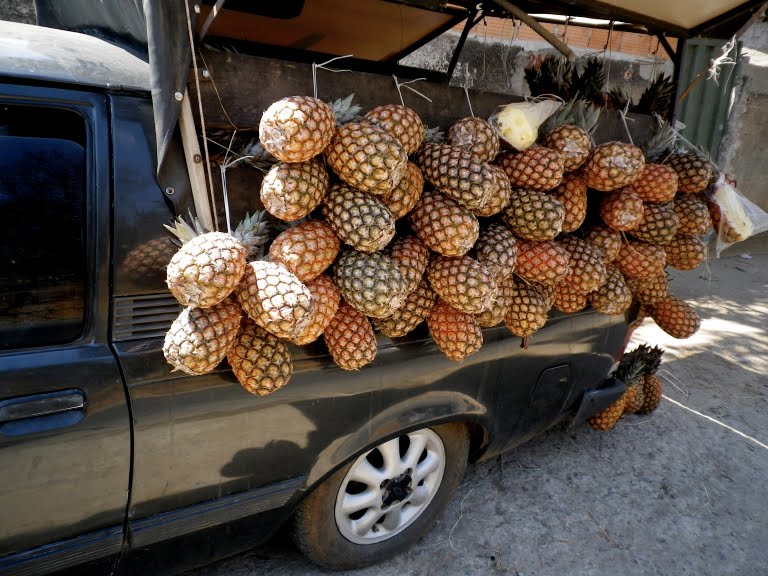 |
| This ute laden down with abacaxi (pineapples) was one of many beside the Estrada Real in Cipó. these guys cut the abacaxi into quarters, bag them, put them on ice, and sell from the roadside for about R$1. On a hot day, fantastic ... |
Cipó ranges in altitude from about 1,000 up to 1,700m, and today we spent some time around 1,400m, in the high cerrado vegetation. Cerrado is a biome unique to Brazil, and though it has parallels with savannah and grasslands, it's neither really - and exists as a continuum between treeless vegetation right through to gallery forest - but has sclerophyllous shrubs even in the most open formations. The biodiversity is very high; more so than for any other grassy system (apparently).
 |
| Scrubby cerrado at Cachoeira da Capivara |
 |
| More of the same ... high cerrado |
On the long weekend for Brazilian Independence Day (coming on Tuesday, 7/9/2010), the main interest in Cipó for Brazilians is in taking it easy near water, whilst eating, drinking, kicking footballs, and walking the cerrado trails.
 |
| Enjoying the view - snapped by Thiago |
 |
| Juquinha and me ... |
 |
| Slave labour built this trail to Cachoeira da Capivara |
 |
| Thiago admiring the view from the top |
 |
| After slogging up the hill in low 30s heat, the cool water in the pool above the falls was irresistible. |
Cidade Administrativa
Oscar Niemeyer is 102 years old, and still designing eye-popping public buildings in Brazil. Check out his most recent commission, Cidade Adminstrativa in Belo Horizonte, Minas Gerais state. The photo is taken from a chopper (not by me), but the effect is more striking at ground level as you zoom along the nearby motorway.
His work might be described as alienating and cold, but you can't accuse him of being dull! The two large intersecting office towers house the 10,000+ state bureaucrats. The smaller building inside the kind of white armature is the governor's office! The building is actually suspended from the white framework. Remarkable ...
His work might be described as alienating and cold, but you can't accuse him of being dull! The two large intersecting office towers house the 10,000+ state bureaucrats. The smaller building inside the kind of white armature is the governor's office! The building is actually suspended from the white framework. Remarkable ...
Saturday, September 4, 2010
Ouro Preto
Despite my infatuation with Belô, today we headed out to the famous brasileira baroque city of Ouro Preto (= black gold), about 90km to the SE. Most of the remarkable baroque architecture in Ouro Preto was built from the 1690s onwards, until the gold started to dwindle in quantity. So called black gold because of the iron rich soil and rock strata around here, giving the gold a coating of oxidised iron and making it look greyish-black.
Famous for its churches, the narrow cobbled streets of the old town also have the ambience of 17th century Europe, plus a startling modern intrusion in the form of the Grande Hotel designed by Oscar Niemayer in 1938 (more famous for work in Brasília and elsewhere around Brazil and the world - like the UN building in New York with Le Corbusier) ... and then of course there's the omnipresent, delicious comida mineiro.
Thiago (from Golder's Belô office) and I hired a guide. João was a retired mining engineer, lifelong resident of Ouro Preto, and of course was a font of information and opinion about everything, but in a well considered kind of way, and with a great sense of humour. Everyone in town seemed to know him, and all the food vendors seemed only too happy to feed him grátis, as he brings paying turistas with him! He earned R$100 (~$AUD60) for about 5 hours of fantastic insights, background, gossip and great companionship.
 |
| Just to prove I am the man behind the camera, here I am in front of it outside the Church of St Francis of Assisi, Ouro Preto |
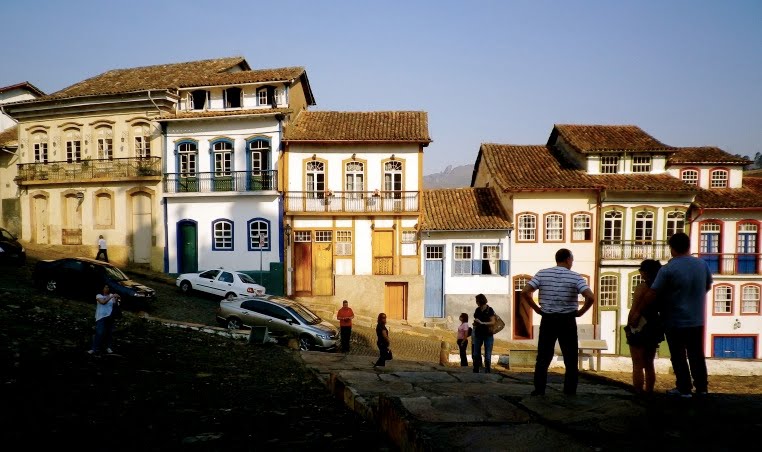 |
| It really is gorgeous ... |
Famous for its churches, the narrow cobbled streets of the old town also have the ambience of 17th century Europe, plus a startling modern intrusion in the form of the Grande Hotel designed by Oscar Niemayer in 1938 (more famous for work in Brasília and elsewhere around Brazil and the world - like the UN building in New York with Le Corbusier) ... and then of course there's the omnipresent, delicious comida mineiro.
 |
| The hot food selection of a typical self-serve comida mineiro lanchonete. |
 |
| Brazil is right up there when it comes to banning smoking in enclosed spaces, and this lanchonete proprietor seems to be in furious agreement - this translates mais ou menos as "Smoking prohibited. Please go outside to die". |
 |
| João on the left, Thiago on the right. Great company in Ouro Preto. |
Friday, September 3, 2010
Leaving São Paulo - arriving in Belo Horizonte
A few days in São Paulo was far more enjoyable than I expected. USP (Universidade de São Paulo) was a definite highlight, but there were others.
This is São Paulo's endemic style of tag graffiti, called pichação or pixação - very 'runic' in appearance, and quite striking. This isn't a great example, just one next to where the bus paused for a moment ...
Leaving São Paulo took ages, as the bus crawled through the back streets around the Rodoviária Tietê on its way to the motorway. Once we got going it was steady progress through the rolling hills of northern São Paulo state and southern Minas Gerais. We had a couple of stops at 'por quillo' lanchonetes along the way. The only glitch in a 9 hour trip was the 45 minute wait at a federal traffic police stop, where they checked all IDs, and searched a few suitcases - quota filling if ever I saw it!!
And so we rolled in to Belo Horizonte at about 8h30pm after leaving Sampa at 11h00am. First impressions - slightly flatter and grottier than sampa around the rodoviária. Once we got to the hotel in Savassi, downtown Belô, it was clear this was a fairly classy party town! People drink and chat here until 2am fairly routinely.
The Golder Belô office is just off downtown savassi, in the bairro known as Funcianários. There are about 90 Golder staff, including 6 biologists. Thiago Alves is the guy I've had contact with for about 12-18 months, and he has covered pretty much everything in making my arrival here a slick affair. This morning he met me at the hotel, walked me down to the office (~5 blocks), and introduced me to pretty much everyone there.
I gave my Golder Melbourne spiel to about 20 people in the Hugh Golder Auditorium at 5pm! Thereafter, Thiago, Bernardo and Fernando dragged me down to the Clube da Esquina, and forced me to drink beer (Antarctica Original and Brahma chopp, aka draught beer) whilst consuming tasty comida mineiro equivalents of tapas. This after a fantastic comida mineiro lunch. I think the rose-coloured glasses have kicked in, and I'm having an instantaneous infatuation with Belô!
 |
| Rio Pinheiro from Golder's São Paulo office |
This is São Paulo's endemic style of tag graffiti, called pichação or pixação - very 'runic' in appearance, and quite striking. This isn't a great example, just one next to where the bus paused for a moment ...
 |
| pixação |
Leaving São Paulo took ages, as the bus crawled through the back streets around the Rodoviária Tietê on its way to the motorway. Once we got going it was steady progress through the rolling hills of northern São Paulo state and southern Minas Gerais. We had a couple of stops at 'por quillo' lanchonetes along the way. The only glitch in a 9 hour trip was the 45 minute wait at a federal traffic police stop, where they checked all IDs, and searched a few suitcases - quota filling if ever I saw it!!
 |
| tchau-tchau São Paulo |
And so we rolled in to Belo Horizonte at about 8h30pm after leaving Sampa at 11h00am. First impressions - slightly flatter and grottier than sampa around the rodoviária. Once we got to the hotel in Savassi, downtown Belô, it was clear this was a fairly classy party town! People drink and chat here until 2am fairly routinely.
The Golder Belô office is just off downtown savassi, in the bairro known as Funcianários. There are about 90 Golder staff, including 6 biologists. Thiago Alves is the guy I've had contact with for about 12-18 months, and he has covered pretty much everything in making my arrival here a slick affair. This morning he met me at the hotel, walked me down to the office (~5 blocks), and introduced me to pretty much everyone there.
 |
| bairro Funcionários, downtown Belô |
I gave my Golder Melbourne spiel to about 20 people in the Hugh Golder Auditorium at 5pm! Thereafter, Thiago, Bernardo and Fernando dragged me down to the Clube da Esquina, and forced me to drink beer (Antarctica Original and Brahma chopp, aka draught beer) whilst consuming tasty comida mineiro equivalents of tapas. This after a fantastic comida mineiro lunch. I think the rose-coloured glasses have kicked in, and I'm having an instantaneous infatuation with Belô!
Tuesday, August 31, 2010
Nobody warned me about pão de queijo!
These things are delicious! How to describe - kind of like a cheesy scone, only immeasurably better. Chewy, cheesy little buns, crisp on the outside, made from tapioca flour and queijo do Minas (or some combination of parmesan/mozzarella if you don't live in Brazil). Maybe the greatest thing to come out of Minas Gerais apart from coffee.
Subscribe to:
Posts (Atom)